









- Focus and Scope
- Section Policies
- Peer Review Process
- Publication Frequency
- Open Access Policy
- Publication Ethics
- References Management
- Plagiarism Checker
- Digital Preservation and Archiving Policy
- Journal Ownership and Management
Focus and Scope
The Journal of Business and Applied Management publishes original research articles in the fields of business and management. The journal welcomes empirical and conceptual studies that contribute to the development of knowledge, theory, and practice in business and management. It encourages research addressing contemporary business challenges, emerging trends, and managerial practices across different industries and organizational contexts.
The journal covers the following areas:
Human Resource Management
This area covers research on the management and development of human resources within organizations. Topics include recruitment and selection, employee training and development, performance management, compensation and benefits, employee engagement, organizational behavior, leadership, organizational culture, and human resource strategies that contribute to employee and organizational performance.
Marketing
Marketing covers research on strategies and practices related to understanding, attracting, and retaining customers. Topics include consumer behavior, marketing strategies, digital marketing, branding, advertising, customer relationship management, customer experience, market research, and product and service marketing. This area also welcomes studies exploring changing consumer preferences, market trends, and developments in marketing practices.
Finance
Finance covers research on financial management, investment decisions, and financial strategies within business organizations. Topics include corporate finance, financial planning, capital structure, financial risk management, investment management, financial performance, and financial decision-making. This area welcomes studies examining how organizations manage financial resources and respond to changing financial and business environments.
Banking
Banking covers research on the management, operations, and strategic development of banking institutions and financial services. Topics include banking strategies, digital banking transformation, financial service innovation, customer behavior and experience, service quality, financial technology adoption, and banking performance. This area also welcomes studies examining how banking institutions respond to changing market conditions, technological developments, and evolving customer needs.
Business Strategy
Business Strategy covers research on strategic planning, strategic management, and decision-making processes that influence organizational competitiveness and performance. Topics include business model development, competitive strategies, strategic innovation, organizational capabilities, business growth, entrepreneurship, and strategic responses to changes in the business environment. This area also welcomes studies exploring how organizations formulate, implement, and evaluate strategies to achieve their business objectives.
Digital Business
Digital Business covers research on the application and integration of digital technologies in business operations, strategies, and organizational development. Topics include digital transformation, digital business models, e-commerce, digital platforms, business process innovation, digital entrepreneurship, and technology-driven business strategies. This area also welcomes studies examining how digital technologies influence business performance, customer experience, organizational capabilities, and competitive advantage.
Section Policies
Articles
The Articles section of the Journal of Business and Applied Management publishes original scholarly articles that contribute to the development of knowledge, theory, and practice in business and management.
This section welcomes empirical and conceptual research within the journal's focus and scope, including Human Resource Management, Marketing, Finance, Banking, Business Strategy, and Digital Business.
Submitted manuscripts must present a clear research objective, appropriate theoretical foundation, sound research methodology or analytical approach, meaningful findings or arguments, and a relevant contribution to the field of business and management.
All manuscripts submitted to this section undergo an initial editorial screening to assess their relevance, originality, compliance with the journal's author guidelines, and adherence to publication ethics. Manuscripts that pass the initial screening proceed to the journal's peer review process.
The journal currently applies double-blind peer review as its standard review procedure. In earlier publication periods, the journal also applied single-blind peer review.
Editorial decisions are based on the scientific quality of the manuscript, reviewers' recommendations, and the journal's editorial standards.
Authors must prepare their manuscripts using the journal's latest official article template and comply with its submission requirements, publication ethics, and reference style.
Only manuscripts that meet the journal's scientific, editorial, and ethical standards will be considered for publication.
 Open Submissions |
Indexed |
Peer Reviewed |
Peer Review Process
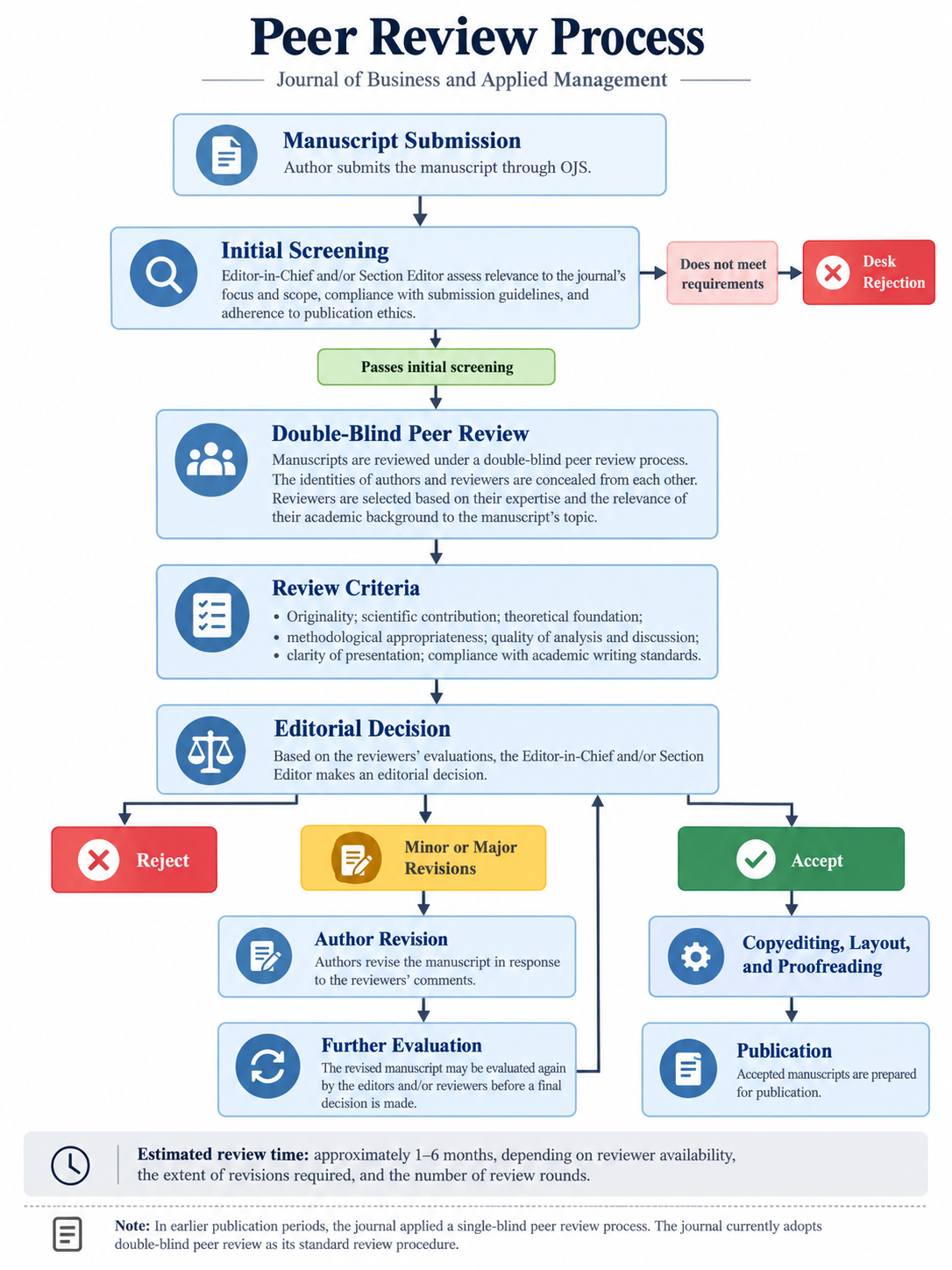
All manuscripts submitted to the Journal of Business and Applied Management undergo an initial screening by the Editor-in-Chief and/or Section Editor to assess their relevance to the journal's focus and scope, compliance with submission guidelines, and adherence to publication ethics. Manuscripts that do not meet these requirements may be rejected at this stage without further review.
Manuscripts that pass the initial screening proceed to a double-blind peer review process, in which the identities of the authors and reviewers are concealed from each other. Reviewers are selected based on their expertise and the relevance of their academic background to the manuscript's topic. In earlier publication periods, the journal applied a single-blind peer review process, in which reviewers' identities were concealed from authors. As part of its ongoing efforts to strengthen editorial quality and publication standards, the journal has since transitioned to double-blind peer review as its standard review procedure.
During the review process, manuscripts are evaluated based on their originality, scientific contribution, theoretical foundation, methodological appropriateness, quality of analysis and discussion, clarity of presentation, and compliance with academic writing standards. Reviewers provide constructive comments and recommendations to assist the editors in making editorial decisions.
Based on the reviewers' evaluations, the Editor-in-Chief and/or Section Editor may decide to accept the manuscript, request minor or major revisions, or reject the submission. When revisions are required, authors are expected to address the reviewers' comments and submit a revised manuscript. The revised manuscript may undergo further evaluation by the editors and/or reviewers before a final decision is made.
The peer review process generally takes approximately 1–6 months, depending on reviewer availability, the extent of revisions required, and the number of review rounds. The final decision regarding manuscript acceptance or rejection rests with the editorial team, based on the reviewers' recommendations and the journal's editorial standards.
Accepted manuscripts proceed to the copyediting, layout, and proofreading stages before publication.
Publication Frequency
The Journal of Business and Applied Management is published twice a year, in March and September. Each annual volume consists of two issues, with Issue 1 published in March and Issue 2 published in September. Articles are published electronically through the journal's Online Journal System (OJS).
Open Access Policy
The Journal of Business and Applied Management provides immediate open access to all published articles. Readers may access, read, download, and share published content without subscription fees or registration requirements, subject to the Creative Commons license applicable to each article.
The journal supports the free dissemination of scholarly research in business and management to encourage knowledge development, academic collaboration, and the wider use of research findings.
Authors retain the copyright of their published articles and grant the journal the right of first publication. Further information is provided in the journal's Copyright Notice and Licensing Policy.
Publication Ethics
The Journal of Business and Applied Management is a peer-reviewed academic journal published by Universitas Bunda Mulia, Indonesia, and managed by its Program Studi Magister Manajemen. The journal is committed to maintaining academic integrity, transparency, fairness, and ethical standards throughout the publication process.
This publication ethics statement outlines the responsibilities of the publisher, editors, peer reviewers, and authors. It is guided by the principles and recommendations of the Committee on Publication Ethics (COPE) and the ethical standards applicable to scholarly publishing in Indonesia.
The journal expects all parties involved in the publication process to uphold research integrity, respect intellectual property rights, and contribute to the publication of reliable and original scholarly work.
1. Duties of the Publisher
Editorial Independence
The publisher supports the independence of the editorial team in evaluating and selecting manuscripts for publication. Editorial decisions must be based on scientific quality, originality, relevance, and compliance with the journal's policies, without inappropriate influence from institutional, financial, or personal interests.
Publication Integrity
The publisher supports the editorial team in maintaining the integrity of published articles and addressing concerns related to publication ethics. When necessary, the publisher may assist the editorial team in communicating with authors, reviewers, academic institutions, or other publishers regarding suspected ethical violations.
2. Duties of Editors
Publication Decisions
The Editor-in-Chief and/or Section Editors are responsible for evaluating submitted manuscripts and making editorial decisions based on their relevance to the journal's focus and scope, originality, scientific contribution, methodological quality, and compliance with publication ethics.
Editorial decisions may include acceptance, minor revision, major revision, or rejection. Manuscripts that do not meet the journal's requirements may be rejected during the initial screening without proceeding to external peer review.
Fair and Objective Evaluation
Editors must evaluate manuscripts fairly and objectively, without discrimination based on the authors' gender, nationality, ethnicity, religion, institutional affiliation, or other personal characteristics unrelated to the scientific quality of the research.
Confidentiality
Editors and editorial staff must maintain the confidentiality of submitted manuscripts and related communications. Information concerning a manuscript may only be shared with individuals directly involved in the editorial and review process.
Unpublished materials must not be disclosed or used for personal research or other purposes without appropriate authorization.
Conflicts of Interest
Editors must disclose any personal, professional, institutional, or financial relationships that could influence their editorial judgment. Editors with potential conflicts of interest must withdraw from handling the relevant manuscript, which should be assigned to another qualified editor.
Manuscripts submitted by editorial board members or researchers affiliated with the publisher must be evaluated independently to maintain fairness and editorial integrity.
Responsibilities in Peer Review
Editors are responsible for selecting qualified reviewers whose expertise is relevant to the manuscript's subject and methodology. They must ensure that reviewers provide objective and constructive evaluations.
The journal currently applies a double-blind peer review process, in which the identities of authors and reviewers are concealed from each other. In earlier publication periods, the journal applied a single-blind peer review process.
The editorial team considers reviewers' recommendations when making publication decisions while retaining responsibility for the final editorial decision.
3. Duties of Peer Reviewers
Contribution to Editorial Decisions
Peer reviewers are responsible for providing objective, constructive, and academically justified evaluations to assist the editorial team in determining the suitability of manuscripts for publication.
Competence and Timeliness
Reviewers should accept review invitations only when they have sufficient expertise in the manuscript's subject area and can complete the review within the requested period.
Reviewers who are unable to conduct an appropriate or timely review should promptly inform the editor.
Confidentiality
Manuscripts received for review must be treated as confidential documents. Reviewers must not share, reproduce, or discuss unpublished manuscripts with unauthorized individuals.
Information obtained during peer review must not be used for personal, professional, or academic advantage.
Objectivity and Constructive Feedback
Reviews must be conducted objectively and supported by clear academic arguments. Reviewers should assess the manuscript's originality, theoretical foundation, research methodology, data analysis, discussion, scientific contribution, and clarity of presentation.
Personal criticism, discriminatory remarks, and comments unrelated to the manuscript's academic quality are not acceptable.
Acknowledgement of Sources
Reviewers should identify important relevant studies that have not been appropriately acknowledged by the authors. They should also inform the editor of any substantial similarities between the manuscript and previously published work of which they are aware.
Conflicts of Interest
Reviewers must disclose any conflicts of interest arising from personal, professional, financial, institutional, or collaborative relationships that may affect their impartiality. Reviewers with such conflicts should decline the review invitation or seek guidance from the editor.
Use of Artificial Intelligence
Reviewers are prohibited from using artificial intelligence (AI) tools to conduct manuscript evaluations or generate peer review reports.
Reviewers must not upload or disclose any part of an unpublished manuscript to AI platforms or unauthorized third parties. All review reports must reflect the reviewer's own independent academic judgment.
4. Duties of Authors
Reporting Standards and Research Integrity
Authors must present their research accurately, objectively, and transparently. Manuscripts should provide sufficient information about the research objectives, theoretical foundation, methodology, data analysis, findings, and conclusions.
Fabrication, falsification, deliberate misrepresentation, or inappropriate manipulation of research data and findings are strictly prohibited.
Authors are responsible for ensuring that their research complies with applicable academic and ethical standards.
Originality and Plagiarism
Authors must ensure that submitted manuscripts are original and that all ideas, findings, data, and materials obtained from other sources are appropriately acknowledged.
Plagiarism, including the unauthorized use of another person's work or ideas, is prohibited. Inappropriate reuse of previously published material without proper acknowledgment is also unacceptable.
The journal uses Turnitin to support similarity checking during the initial screening and before publication. Similarity reports are evaluated by the editorial team, considering the nature and context of the identified similarities. A similarity percentage alone does not determine whether plagiarism has occurred.
Multiple and Concurrent Submissions
Authors must not submit the same manuscript to more than one journal simultaneously.
Manuscripts that substantially duplicate previously published research without appropriate disclosure or justification are not acceptable. Authors must disclose any related publications or manuscripts that may overlap with the submitted work.
Authorship and Contributions
Authorship must be limited to individuals who have made substantial intellectual contributions to the research and accept responsibility for the published work.
All listed authors must approve the submitted manuscript and agree to its publication. Individuals who have contributed to the research but do not qualify for authorship should be appropriately acknowledged.
The corresponding author is responsible for ensuring the accuracy of authorship information. Any request to add, remove, or change the order of authors must be supported by an appropriate explanation and agreement among the authors concerned, subject to editorial approval.
Acknowledgement of Sources
Authors must appropriately cite relevant scholarly publications and other sources that have contributed to their research.
References should be accurate, relevant, and consistent with the journal's author guidelines. Citation manipulation intended to artificially increase citation counts is not acceptable.
Data Accuracy and Availability
Authors are responsible for the accuracy and integrity of the data used in their research. Relevant research data should be retained for an appropriate period and made available for editorial verification when necessary and permissible.
Data sharing must respect participant confidentiality, informed consent, institutional requirements, and applicable data protection regulations.
Research Ethics and Informed Consent
Research involving human participants, including surveys, interviews, experiments, or the collection of personal information, must comply with applicable ethical principles and institutional requirements.
Where formal ethical approval is required, authors must obtain approval from an appropriate research ethics committee or institutional review board before conducting the study.
Authors must provide information about ethical approval, including the approving institution, approval number, and date, when applicable.
If formal ethical approval is not required or an exemption applies under relevant institutional or regulatory provisions, authors must provide an appropriate explanation. The journal may request supporting documentation to verify compliance with applicable research ethics requirements.
Where required, informed consent must be obtained from research participants. Authors must also protect participants' privacy, confidentiality, and personal information.
Disclosure of Conflicts of Interest and Funding
Authors must disclose any financial, professional, institutional, or personal relationships that could influence the research or its interpretation.
All relevant sources of research funding must be acknowledged. If no conflicts of interest or external funding exist, authors should provide an appropriate statement.
Use of Artificial Intelligence
Authors remain fully responsible for the originality, accuracy, and integrity of their manuscripts, including content prepared with the assistance of artificial intelligence (AI) tools.
The use of generative AI in developing or preparing scientific content must be disclosed transparently, including the name of the tool and its purpose.
AI tools must not be listed as authors or co-authors. Authors are responsible for independently verifying AI-assisted content, including factual statements, references, analyses, and conclusions.
The use of AI does not reduce authors' responsibility for complying with the journal's publication ethics and academic integrity requirements.
Fundamental Errors in Published Works
When authors discover significant errors or inaccuracies in their published articles, they must promptly inform the editorial team and cooperate in determining the appropriate corrective action.
Depending on the nature and seriousness of the issue, the journal may publish a correction, issue an expression of concern, or retract the article.
5. Handling Research and Publication Misconduct
The Journal of Business and Applied Management is committed to addressing suspected research and publication misconduct fairly and responsibly.
Potential violations include plagiarism, data fabrication, data falsification, inappropriate authorship, duplicate publication, citation manipulation, undisclosed conflicts of interest, and other practices that compromise academic integrity.
Concerns regarding suspected misconduct may be reported through the journal's official contact information. Reports should include sufficient information or supporting evidence to allow an appropriate assessment.
The editorial team will assess the concern and may request clarification or supporting documentation from the parties involved. When necessary, the journal may consult relevant academic institutions or other appropriate parties.
All reported concerns will be handled with reasonable confidentiality, fairness, and consideration of the available evidence.
Depending on the findings, appropriate editorial actions may include manuscript rejection, publication of a correction, issuance of an expression of concern, or article retraction.
6. Corrections, Retractions, and Expressions of Concern
The journal is committed to maintaining the accuracy and integrity of the published scholarly record.
Corrections
A correction may be published when an article contains significant errors that require amendment but do not invalidate its main findings or conclusions.
Correction notices will identify the article concerned and describe the necessary amendments.
Retractions
An article may be retracted when there is sufficient evidence that its findings are unreliable or that serious violations of publication ethics have occurred.
Retractions may result from substantial plagiarism, fabricated or falsified data, duplicate publication, serious ethical violations, or other circumstances that undermine the reliability of the published work.
Retraction notices will explain the reasons for the action and remain publicly accessible. The original article will be clearly identified as retracted.
Expressions of Concern
An expression of concern may be issued when serious questions arise regarding a published article but the available evidence is insufficient to reach a final conclusion.
Where technically possible, corrections, retractions, and expressions of concern will be linked to the original articles and reflected in the relevant publication records.
7. Complaints, Appeals, and Post-Publication Concerns
The journal welcomes legitimate concerns regarding editorial procedures, publication ethics, and the accuracy or integrity of published research.
Authors may submit appeals against editorial decisions when they believe that a significant procedural error, factual misunderstanding, or other legitimate concern has affected the evaluation of their manuscript.
Complaints and appeals should be submitted through the journal's official contact channels, accompanied by relevant explanations or supporting evidence.
The editorial team will assess the concerns objectively and determine whether further review or clarification is necessary. An appeal does not automatically result in reconsideration or acceptance of a manuscript.
Complaints involving a potential conflict of interest will be handled by an appropriate editor or representative who is not directly involved in the matter.
The journal also encourages constructive academic discussion of published research. Readers may submit evidence-based comments or concerns regarding the methods, findings, interpretations, or research integrity of published articles.
Where appropriate, the editorial team may request clarification from the authors or take further editorial action.
All authors, editors, reviewers, and other parties involved in the publication process are expected to comply with this Publication Ethics policy. The journal may review and update the policy as necessary to maintain responsible, transparent, and credible scholarly publishing practices.
References Management
In writing Citation and Bibliography, editor Journal of Business and Applied Management suggests authors to use the Mendeley Reference Management Software.
Plagiarism Checker
Every submitted paper to Journal of Business and Applied Management will go through plagiarism checking by Turnitin in initial process of paper screening and before publishing it in an issue.
Digital Preservation and Archiving Policy
Digital Preservation and Archiving Policy
The Journal of Business and Applied Management is committed to maintaining the accessibility and long-term preservation of its published articles and associated metadata.
Published articles are maintained through the journal's online publishing system, which provides access to current and previous issues. The journal works with the publishing institution and its information technology administrators to support the continuity, security, and recovery of its digital content.
The journal will periodically review its archiving and preservation practices to ensure the continued accessibility of its published scholarly content.
For inquiries concerning archived articles or the availability of published content, readers may contact the journal's editorial office.
Journal Ownership and Management
The Journal of Business and Applied Management (JOBAM) is a peer-reviewed, open-access scholarly journal published by Universitas Bunda Mulia Press and managed by the Program Studi Magister Manajemen, Universitas Bunda Mulia, Jakarta, Indonesia.
The journal operates under the institutional responsibility of Universitas Bunda Mulia, which supports its publication activities, journal management, and the dissemination of scholarly research in business and management.
Editorial Management
The journal is managed by an Editor-in-Chief, supported by an Editorial Board and peer reviewers with academic expertise relevant to the journal's focus and scope. The Editor-in-Chief is responsible for overseeing the editorial process, maintaining publication standards, and making final editorial decisions based on the journal's policies and peer-review evaluations.
The Editorial Board supports the journal in maintaining academic quality, developing editorial policies, and ensuring that published articles meet appropriate scholarly standards. Peer reviewers provide independent academic assessments of submitted manuscripts.
Editorial Independence
Editorial decisions are based on the scientific quality, originality, methodological appropriateness, and relevance of submitted manuscripts to the journal's focus and scope. The journal is committed to maintaining editorial independence and ensuring that decisions on manuscript acceptance or rejection are not influenced by the authors' institutional affiliations, personal relationships, or other non-academic considerations.
Publication Management and Responsibilities
The journal's management is responsible for coordinating manuscript submissions, peer review, editorial processing, publication scheduling, and the online dissemination of published articles through its Open Journal Systems (OJS) platform.
The journal is committed to transparency, publication ethics, and responsible editorial practices in accordance with its established policies.
Publisher and Editorial Office
Universitas Bunda Mulia Press
Program Studi Magister Manajemen
Universitas Bunda Mulia
Lantai 3, Ruang Pascasarjana
Jl. Lodan Raya No. 2, Ancol, Jakarta Utara 14430, Indonesia
Email: [email protected]
Further information about the journal's editorial structure and contact details is available on the official journal website.
UNIVERSITAS BUNDA MULIA PRESS
PROGRAM STUDI MAGISTER MANAJEMEN
Lantai 3 Ruang Pascasarjana - Universitas Bunda Mulia
Jl. Lodan Raya No. 2, Ancol – Jakarta Utara 14430, Indonesia
Telp: +62 21 692 9090 ext.1317
Email: [email protected]